A recurring theme throughout the book was the idea of these "three little words", thus, the title of the story. As I read, I began to learn that the three words were "I love you", and the book helped define what that actually means- to love someone. Ashley had been abused for half of her life by foster mothers, never understanding the true meaning of love. She didn't belong anywhere, and she never had a home. It took over 195 people to find the two people who would save her from foster care. When she said those "three little words", it altered her life, as well as the world's life because she was able to put it into words and publish it. I think what Rhodes was trying to teach her audience was that life will throw struggles out that don't seem fair. There will be times where you won't know if you'll survive this time or make it to tomorrow. The only thing that keeps you from jumping off of that mental cliff is hope. Love teaches hope. As Rhodes crawls her way to the appallingly flawed American foster care system, the audience is taken along for the ride, and Rhodes doesn't fail to convey her strength over and over again. By the end of the book, the reader realizes that not only did Rhodes make it through all of her struggles, but she was able to do more than that- she was able to live a part of the American dream by writing her book. It's incredible that after nine traumatic years, Rhodes was able to accomplish writing a book and overcoming her battles. I respect her not only as an author, but as a person.
Sunday, January 26, 2014
TOW #16: IRB Final Review
Three Little Words was a phenomenal book. Ashley Rhodes is one of my new favorite authors, not only because of the plot and storyline, but because of her style and the way she writes. She writes as though the reader is sitting there in the situation, not as if the reader is an outsider looking into an foggy window. I would definitely say, above all, her descriptiveness and metaphors were the most outstanding elements of her book. For example, one way she described herself in the book was, "As we pulled out of the driveway, I heard a shattering sound inside my head as if a glass had broken between my ears...I was escaping, and yet, I felt as worthless as the junk in my trash bag. Once again, I was the one being tossed and thrown away." (Rhodes, 74) As the author describes herself as a piece of trash being tossed into the garbage can, the audience can imagine how small and worthless she had been feeling.

Sunday, January 12, 2014
TOW #15 School Uniforms: Yes or No?
It's an age old debate; it's a debate on which I have been writing TEAC and 5-paragraph sample essays for probably about the last five years of my life. School uniforms. Do we need them, or are they just a hassle? Noelle McGee, who writes for a local Illinois newspaper, wrote an article about the pros of a school mandating uniforms. Sandra Chereb, who writes for a local Carson City, Nevada paper, wrote an article about a hearing at the Nevada Supreme Court in which two parents were having issues paying for uniforms, and listed the cons. Because one article was written distinctly better than the other, my opinion about uniforms changed. Because
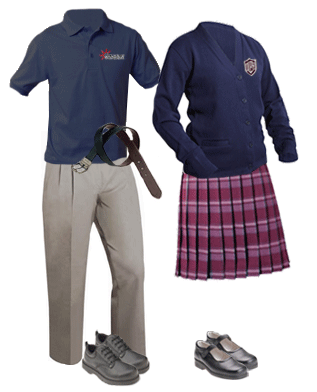
Noelle McGee writes, "'We believe that will help eliminate some of the time spent on correcting the dress code and decrease other problems like bullying and gang violence.'" This is a quote from the principal of a middle school principal in Illinois. When I read this, I immediately thought of how people dress in the halls of Wissahickon High School. While some students dress very conservatively, covering almost every inch of their bodies, some walk into the building with shirts that barely cover half of their torso. It's an extremely interesting concept, that of the dress code. It raises the question of whether or not disallowing students to wear inappropriate clothing will create a more business-like and professional environment for students to learn. It will also eliminate the bullying that subsequently appears because of name brands. Many can not afford it.
Sandra Chereb made the same argument, about the parents not being able to afford school uniforms, but it wouldn't matter, as long as they would fit the dress code. This could be a collared shirt and khakis. IT wouldn't be an insane price like some uniforms are. This actually made me overthink uniforms. It would prevent bullying, and I think the professional atmosphere would be better for students to learn.
Sunday, January 5, 2014
TOW #14 AT&T Commercial
http://www.youtube.com/watch?v=Ijeg-jeTUBs
The AT&T commercial never fails to have my family and me glued to the screen because it's so adorable, but as I continue to learn about logical fallacies, I have to begin to question: how effective is the ad? Of course, the commercial changes every so often, and normally, it is the same actor sitting with a group of four or five very young children in a classroom at a table. The whole idea of the commercial is that switching to AT&T is not complicated, and neither is having AT&T. What doesn't make sense, though, is the fact that the commercial takes the idea from little children, and then transposes it to the oh-so-powerful phone company. Although extremely adorable and occasionally humorous, it is hard to take this commercial and say it's effective. This fallacy would be called false authority, because this would make better sense if it was a toy store company or even an ad for juice boxes or something more immature, but making it about a phone company doesn't make much sense. Another example of this fallacy would be celebrities who have nothing to do with a certain product, being advertised with it or even advertising it themselves.
Rhetorically analyzing the AT&T commercial, though, the commercial does have it's humorous moments, and the children on it are usually extremely adorable. It leaves me wondering if the commercial is scripted. In this way, it is extremely effective because it definitely catches the audience's attention while also keeping them interested. I'm starting to understand that this applies to many commercials, in the sense that even though many ads and commercials contain logical fallacies, these logical fallacies may actually help contribute to the commercial. While straying a bit from the commercials purpose, it may keep the audience entertained, and give them something to remember by the end of it.
Sunday, December 15, 2013
Tow #13 Why College Football Should be Banned
http://online.wsj.com/news/articles/SB10001424052702304743704577382292376194220
May of 2012, Buzz Bissenger wrote an extremely bold yet thought-provoking article about why college football should be banned. His main reason? Well, to start, he says, "In more than 20 years I've spent studying the issue, I have yet to hear a convincing argument that college football has anything to do with what is presumably the primary purpose of higher education: academics." (Bussinger 1) Buzz Bissenger claims that college football steers away the students from what they are supposed to be doing at college, which is learning. He also makes the argument that the only people who benefit from college football are the alumni and the coaches that make absurd amounts of money. The students don't benefit. Even the players don't benefit because they're being "exploited by a system in which they don't receive a dime of compensation" (1). Last, Bussinger even begins to trash the concept of the game of football alone, and says that it causes injuries that don't need to happen, including sever head trauma. Although his arguments were legitimate, surprisingly, I did not find his article very effective. This article taught me how NOT to write an argumentative essay. The way he crafted the article was extremely sloppy. He would make one little argument, maybe say a sentence or two about it, and then scurry along to his next argument. This didn't allow his main arguments to stick out in my mind, but instead, it makes the article rather confusing. Something that did help his stance, though, was the example about the university in Baltimore, Maryland. He claims that the school cut 8 varsity sports to create a leaner athletic budget, so that crumbling basketball and football programs would get money, and track and swimming wouldn't. He then went on to explain just how much money the school spent on football, and the numbers blew my mind. A little statistic like that can change the whole meaning of the article, which was fascinating to me. During the timed essays, I'll make sure to use as much background knowledge as I can. The argument was an interesting one, and by the end of the article, I almost agreed with him, but not quite. His statistics helped, but it didn't completely gloss over the fact that the organization was sloppy. Note to self: organization has the same importance as content!
 |
| College students don't benefit from college football, in fact, all they get is a higher tuition. |
Sunday, December 8, 2013
Tow #12 IRB Review
I'm in the midst of reading the book, Three Little Words, by Ashley Rhodes, and so far, I have learned about her childhood. Similar to previous IRB book, this one is about someone who had to overcome hardships. Rhodes uses imagery and dialogue to help the reader understand her difficult situations that she went through during her life. Using imagery, the reader can not only picture what is going on, but it allows us to interpret her dilemma in our own way. For example, Rhodes writes, "Our car always smelled of pickles and mustard from all the fast food we ate in it. I was enjoying my usual kids' meal in the backseat when my mother shouted, "Shit, shit!" A flashing red light made the car's windows glow rosy, and I liked the way my hands looked, as though they were on fire." (24) The way Rhodes uses two different senses, sense of smell and sight, encapsulates her experience in her mother's car. The audience can smell the fast food smell, whether it be McDonald's or Burger King. The reader can picture the glow that turns her hand as red as fire. The descriptors accentuate every action and every
seemingly unimportant detail in the story, which only makes it that much better.
The dialogue has the same kind of effect. Rhodes uses dialogue several times through out her story. Whether it is her mother speaking or her brother or herself, the dialogue makes the story come to life. It puts voices and individuality on each of the characters. It gives every character a personality. Rhodes writes, "I remember the rush of joy as I fell into her arms after one of those interminable separations.
'Sunshine, you're my baby and I'm your only mother. You must listen to the one taking care of you, but she's not your mama. Never forget, I'm the only mama who will love you forever and ever.' She pledged that we would be together soon." (1) Although the readers don't exactly know who her mother is, we can infer that she was a kind-hearted woman, who maybe didn't have enough to support her child. Maybe she wasn't in a good environment to raise one. The fact that she sang that song and made those promises shows that maybe she couldn't pick and choose what happened to her child. It was probably what was best for Ashley. Her mother wasn't thinking for herself. She was selfless.
This book has moved me a bit form the beginning. Learning about the foster care process is very interesting, and I have made a connection to Rhodes as well. I can't wait to continue reading on. Rhodes's imagery and dialogue is extremely effective in getting the reader to understand the situation at hand, and I'm sure it will come more into play throughout the rest of the book as well.
Tuesday, December 3, 2013
Tow #11: Patient by Rachel Reiderer
One leg crushed under a tire, and the other wedged between the second tire and the cold, hard asphalt. And the bus that has mounted itself on top of you? Well, it's not moving. Rachel Reiderer has experienced this before, and wrote an essay on her time under the bus, and in the hospital. In her essay, called, "Patient", Reiderer uses personification and imagery to demonstrate to her audience that although things may be at the worst of times now, there is always a way to look toward the future.
Reiderer uses personification multiple times throughout her essay, especially in reference to the different parts of her body that had been injured when she was caught under a bus. She writes, "My toes would have bent. My feet are pretty and obedient." (2) During the essay, Reiderer cannot bring herself to believe that the incident even occurred at all. Here, she states that her toes would have bent, even though, because of the accident, they could not. She then goes on to personify her feet, claiming that they are "obedient". In another part of the essay, she yells at her leg for hurting her. The audience can see that Reiderer is in extreme pain, and tends to take it out on her body or things besides herself. This is then resolved when she realizes that it is no one's fault that this has happened to her. Things just happen sometimes.
In her essay, Reiderer also uses imagery. Although many of the images she provides are quite grotesque, they do give the reader a sense of the exact situation that she is in, and what she encounters on any given day when stuck in a hospital for almost a quarter of a year. She repeatedly describes her room as off-white wall-papered, giving a bland image for the eerie and lonesome hospital room in which she stays for so long. She gives in depth descriptions of how her leg looks and feels. She writes, "The skin is gone from most of the front and the side, and there is just a mess of red tissue about three inches across..." (6) This describes the brutality of what she deals with every day, and how she has to be positive in order to get through it.
Reiderer is an extremely good writer, and this essay was, in my opinion, amazing. She used personification and imagery to especially emphasize her point that looking toward the future is imperative when in a situation like hers. Sitting in a hospital bed for nearly four months obviously isn't going to be easy, but she was patient.
Reiderer uses personification multiple times throughout her essay, especially in reference to the different parts of her body that had been injured when she was caught under a bus. She writes, "My toes would have bent. My feet are pretty and obedient." (2) During the essay, Reiderer cannot bring herself to believe that the incident even occurred at all. Here, she states that her toes would have bent, even though, because of the accident, they could not. She then goes on to personify her feet, claiming that they are "obedient". In another part of the essay, she yells at her leg for hurting her. The audience can see that Reiderer is in extreme pain, and tends to take it out on her body or things besides herself. This is then resolved when she realizes that it is no one's fault that this has happened to her. Things just happen sometimes.
In her essay, Reiderer also uses imagery. Although many of the images she provides are quite grotesque, they do give the reader a sense of the exact situation that she is in, and what she encounters on any given day when stuck in a hospital for almost a quarter of a year. She repeatedly describes her room as off-white wall-papered, giving a bland image for the eerie and lonesome hospital room in which she stays for so long. She gives in depth descriptions of how her leg looks and feels. She writes, "The skin is gone from most of the front and the side, and there is just a mess of red tissue about three inches across..." (6) This describes the brutality of what she deals with every day, and how she has to be positive in order to get through it.
Reiderer is an extremely good writer, and this essay was, in my opinion, amazing. She used personification and imagery to especially emphasize her point that looking toward the future is imperative when in a situation like hers. Sitting in a hospital bed for nearly four months obviously isn't going to be easy, but she was patient.
Sunday, November 24, 2013
Tow #10 Review of "Gravity"
http://www.huffingtonpost.com/michael-morgenstern/gravity-review-in-space-n_b_4086012.html
In honor of the recently learned effects of claims of policy, fact, and value, I decided to write about a review on a movie I had seen this weekend, "Gravity". Gravity was a film about a woman (Sandra Bullock) who is stuck in space. The most intriguing thing about the movie, however, was not the situation, but it was the reality of every scene. The filming was, in my opinion, incredible, and the review agreed with me. The movie review was written by a man named Michael Morganstern, who writes for the Huffington Post. I found its claim first. The article writes, "I don't usually write movie reviews, but this film was so spectacular and disturbing at the same time, I felt like I had to." (Morgenstern, 1) Automatically, I agreed. The article also makes a claim of value by saying that he wouldn't be surprised if Bullock won an Oscar for best acting, while also saying that her acting performance was "stunning". He also mentions that her character was not only intriguing, but she was the heroine throughout the film. In a way, I feel as if he tries to persuade the audience to see the movie, maybe even twice. What jumped out at me from the article, though, was that he did state some of the claims that could have been made from the other side of the argument. For example, he says that it's "easy to forgive the cheesiness of the film" (Morgenstern 1). Although he agrees with this statement, he also says that it's extremely easy to look past this little flaw because of its achievement in so many other areas. He then goes on to try and oppose a claim that has been made about the script being underdeveloped. I think the article itself was extremely effective in supporting its initial claim. Not only does it praise the filming, the actors, and the director, but it also recognizes the possible opinions that others may have against the film, and addresses those claims as well as the one that the article attempts to make. In my opinion, I did enjoy the movie the first time. The article, though, almost makes me want to see it again.
 |
| Sandra Bullock playing the role of astronaut "Ryan Stone" |
Subscribe to:
Posts (Atom)